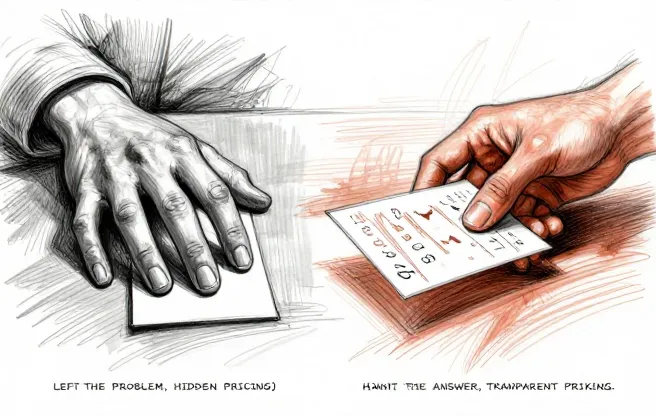
Try this experiment. Go to ten AI consulting firm websites and look for pricing. Actual numbers. Dollar amounts. Ranges, even.
You’ll find it on maybe one of them. Maybe.
We know, because we did this exercise when we were building number6. We looked at over 50 AI consultancies, from solo practitioners to mid-sized firms. 89% had no pricing information anywhere on their site. Most didn’t even hint at ranges. The message was consistent: talk to sales and we’ll tell you what it costs.
We decided to do the opposite. We publish our prices. Here’s why, and why we think the industry’s approach to pricing is bad for everyone involved, including the consultancies.
The “contact us for pricing” problem
When a consultancy hides its pricing, the stated reason is usually some version of “every engagement is different, so we can’t give a standard price.” There’s a kernel of truth in that. Custom AI agent development for a logistics company is a genuinely different project than a half-day training workshop.
But that argument falls apart when you push on it. A restaurant menu covers hundreds of possible meals with different ingredients and preparation, and somehow they manage to list prices. An electrician can give you a ballpark before seeing your house. A lawyer can tell you their hourly rate before knowing your case.
“It’s custom” is not a reason to withhold pricing. It’s an excuse.
Here’s the thing. The real reason most consultancies don’t publish prices is that hidden pricing gives them leverage. If you don’t know what something should cost, you can’t comparison shop. You can’t tell whether you’re getting a fair deal. You’re negotiating blind, and they know it.
What hidden pricing does to buyers
The most immediate effect: you self-select out. Business owners who would benefit from consulting services see a website with no pricing, assume it’s going to be expensive, and never make the call. We’ve talked to dozens of business owners who delayed getting AI help for months because they assumed consulting would cost six figures. For the kind of work we do, that’s usually off by a factor of ten or more.
Then there’s the sunk cost dynamic. By the time you’ve sat through a discovery call, filled out an intake form, maybe had a second conversation, you’re invested. You’ve given up hours of your time. When the price finally arrives, you’re less likely to walk away even if it’s higher than expected. This is by design, not by accident.
And hidden pricing creates an information gap that only benefits one side. The consultancy knows what their competitors charge. You don’t. They know their margins. You don’t. They can price based on what they think you’ll pay rather than what the work is worth. Some will charge a 20-person company half of what they charge a 200-person company for the same deliverable, because nothing stops them.
Why we publish ours
I’ll be direct about our motivation: we publish prices partly because we think it’s the right thing to do, and partly because it’s good business for a firm our size.
We’re a two-person team. We don’t have a sales department. We don’t have the capacity to run 30 discovery calls a month with people who might not be a fit. Published pricing is a filter. People who land on our site can immediately tell whether our services are in their budget. The ones who reach out already know the ballpark. Our conversations are about fit and scope, not about whether they can afford us.
That saves everyone time. Ours and theirs.
But the bigger reason is trust. number6 is built on the idea that AI consulting should be honest, practical, and transparent. If we’re going to tell our clients to be transparent about how they use AI, to document their tools, to be upfront with their teams, we should probably start by being transparent about what we charge.
Asking someone to trust you while refusing to tell them what something costs is a contradiction. We don’t think you can build a trust-based business on information asymmetry.
What “transparent pricing” should actually mean
Publishing a price page isn’t enough on its own. We’ve seen consultancies that list prices but bury the real cost in “implementation fees” or “platform charges” or scope changes that somehow always push the final number 40% above the original quote.
Real transparency means publishing ranges for standard services. Not every engagement can be priced to the dollar in advance, but most fall within predictable ranges. A training workshop costs between X and Y. An AI readiness assessment costs Z. Giving people those numbers up front is both possible and fair.
It also means clear scope definitions. Every price should come with what’s included and what isn’t. “AI Readiness Assessment: $3,500. Includes stakeholder interviews, tool audit, data review, and a written report with recommendations. Does not include implementation.” If the scope might change, explain what triggers a price change before the work starts, not after.
And it means honesty about value, even when it costs you revenue. Sometimes a client asks for something we don’t think is worth the money. We’d rather say “you could get 80% of this result with a $500 tool and two hours of setup” than sell them a $5,000 engagement they don’t need. We lose revenue on that deal. We gain a client who trusts us enough to come back for the work they actually need.
The industry’s counterargument
We should engage with the strongest version of the case against published pricing, because smart people make it.
The argument: publishing prices commoditizes your services. Clients compare on price alone without understanding differences in quality or approach. It attracts bargain shoppers and repels the clients willing to invest in premium work.
There’s something to this. But we think it’s overstated, and it applies more to large firms competing for enterprise contracts than to boutique consultancies serving SMBs.
Our clients aren’t choosing between us and McKinsey. They’re choosing between us and doing nothing, or between us and a freelancer they found on Upwork, or between us and trying to figure it out themselves. For those buyers, price transparency doesn’t commoditize. It de-risks. It takes the scariest part of buying consulting (not knowing what it will cost) off the table.
We’ve also found that publishing prices attracts better-fit clients, not worse ones. People who value transparency tend to value the other things we do: honest assessments, practical recommendations, teaching over dependency. The price page is a signal about what kind of firm we are. It filters in our people.
The catch (because there’s always a catch)
Publishing prices means competitors know what you charge. We’re fine with that. If a competitor can deliver the same quality cheaper, that’s good for clients.
Published prices also mean you can’t charge more for the same work based on a client’s ability to pay. A Fortune 500 company that comes to us pays the same rate as a 30-person startup. Some consultancies view this as leaving money on the table. We view it as integrity.
And yes, some projects genuinely fall outside published ranges. Complex custom development, unusual integrations, engagements that span months. For those, we provide custom quotes. But the published pricing gives the client a baseline. They know what a standard engagement costs, so they can evaluate whether the custom quote makes sense.
How to evaluate a consultant’s pricing model
Whether you work with us or not, here’s what we’d tell any business shopping for an AI consultant.
Ask for a price range before the first call. Any consultant who won’t give you a ballpark isn’t respecting your time. Ask what’s included and what costs extra, because “implementation support” and “ongoing optimization” are where hidden costs tend to live. And ask what happens if the scope changes. Good consultants have a clear policy on this. Vague ones are the ones who send surprise invoices.
If you can only get pricing by sitting through sales calls, something is off. A confident consultant can give you a rough number in an email.
Trust your instinct, too. If a pricing conversation feels like a negotiation instead of a conversation, that’s a preview of how the rest of the engagement will go.
The bigger principle
I’ve spent enough time in this industry to believe that opacity serves the seller and transparency serves the buyer. That’s true in AI consulting. It’s true in most professional services.
We publish our prices because we’d want to see them if we were the one buying. That’s the whole philosophy. It’s not more complicated than that.