“You need to get your data ready before you can use AI.”
You’ve probably heard some version of this. Maybe from a consultant, maybe from a vendor, maybe from a blog post that made it sound like you need a team of data engineers and a six-month project before AI can do anything useful for your business.
Here’s the thing: for most small and mid-sized businesses, that’s not true. You almost certainly have enough data already. The issue isn’t that you don’t have data. The issue is that your data is scattered across different tools, formatted inconsistently, and nobody has thought about how to organize it so an AI tool can actually work with it.
That’s a much more solvable problem than most people think.
What “data” actually means for your business
When AI companies talk about data, they’re often thinking about massive datasets, millions of records, training sets for machine learning models. That’s not what we’re talking about.
For a 50-person company, “data” is much simpler. It’s your emails and documents. Your spreadsheets and CRM records. Customer support tickets, project files, SOPs. The information your business produces and uses every day.
You’re not building a machine learning model from scratch. You’re using off-the-shelf AI tools (ChatGPT, Claude, Copilot, and others) that already know how to read, write, and analyze text. What they need from you is access to your business information in a form they can work with.
That’s what “AI-ready data” means in practice. Your existing business information, organized well enough that you can find things and feed them to an AI tool. Not a data warehouse. Not a data lake.
The real problem: your information is everywhere
Think about how information actually flows in your company. Your sales team keeps proposals in a shared drive, but some people save them in personal folders. Customer information lives in the CRM, except for the notes your senior salesperson keeps in a spreadsheet on their desktop. Company policies are in a Google Doc that was last updated 18 months ago, plus some informal rules that exist only in people’s heads.
Sound familiar? This is the norm. Not the exception.
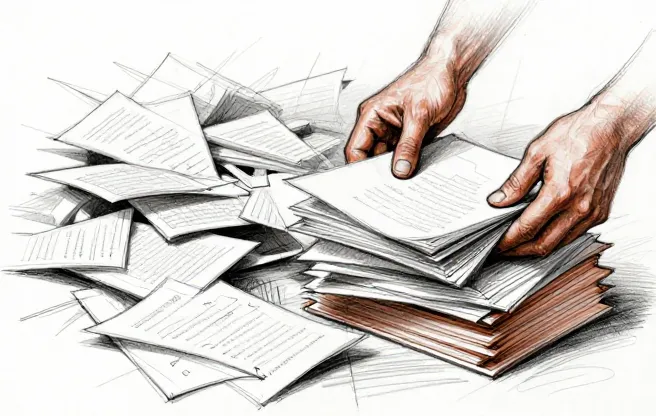
The problem this creates for AI tools is straightforward. If you want an AI to help draft a proposal based on similar past proposals, it needs to be able to find those past proposals. If they’re scattered across five different locations in three different formats with inconsistent naming, the AI can’t work with them.
This isn’t a technology problem. It’s an organization problem. And you don’t need a data engineer to fix it.
What “clean data” actually looks like
“Clean your data” is advice that sounds simple and feels overwhelming. So let’s break it down into what actually matters for AI readiness at a small business.
The biggest one is consistent naming. If your team saves files as “Proposal_Acme_2025,” “acme proposal FINAL,” “Acme_draft_v3_FINAL_FINAL,” and “prop-acme,” an AI tool searching for proposals related to Acme will miss some of them. Pick a naming convention. Any convention. Use it consistently. This alone makes a surprising difference.
Each type of information should have one place where the current, correct version lives. Customer contact info is in the CRM. Proposals are in the shared drive. Policies are in the wiki. You don’t need a single master database for everything. But when someone asks “where do I find X?” the answer should be a specific location, not “check with Sarah.”
AI tools are also much better at working with information that has basic metadata attached: dates, customer names, project names, categories. A spreadsheet with columns for “Date,” “Customer,” “Category,” and “Amount” is infinitely more useful than one with unlabeled columns and merged cells. This sounds obvious, but you’d be surprised how many business-critical spreadsheets we’ve seen that only make sense to the person who created them.
And take an hour to remove the obviously outdated stuff. That policy document from 2019 that nobody follows anymore? That duplicate folder from when someone reorganized the shared drive? Getting rid of clearly outdated information means the AI tool won’t accidentally reference it when helping your team.
You don’t need a data engineering team
I want to be clear about this, because the “data readiness” conversation can spiral into something that feels impossibly expensive and complex.
For a company of 50 people trying to get value from off-the-shelf AI tools, here’s what the project actually looks like: one person spends a week organizing your shared files. They set up a clear folder structure, establish naming conventions, and move the important documents into the right places. This is boring work. It’s also the single highest-impact thing you can do to make AI tools useful.
Going forward, you need a simple rule: when someone creates a document or updates a spreadsheet, it goes in the right place with the right name. This doesn’t require a complex process. It requires a one-page guide and a manager who enforces it for the first month until it becomes habit.
If your CRM data is messy (and it probably is, most are), spend a day or two fixing the worst of it. Duplicate records, missing fields, outdated contacts. Most CRMs have built-in tools for deduplication and cleanup. AI tools that work with customer data are only as good as the customer data you give them.
That’s the whole “data readiness” project for most small businesses. A person, a week, and some clear decisions about how to organize things going forward.
The catch (because there’s always a catch)
We’ll be honest: organizing your data is one of those tasks that’s simple to describe and tedious to do. It’s not technically difficult, but it requires someone to sit down and actually do it, which means taking time away from their regular work.
The other catch is maintenance. Getting organized is a one-time effort. Staying organized requires ongoing discipline. Without some enforcement, your team will slowly drift back into saving things in random places with random names. Build the organizational rules into your onboarding process for new employees, and do a quick check every quarter to make sure things haven’t drifted too far.
And here’s something that trips up a lot of businesses: the information that’s hardest to organize is the information that lives in people’s heads. The senior employee who knows all the edge cases. The sales rep who remembers every client’s preferences. The operations person who knows why that process works the way it does. AI tools can’t access any of that until someone writes it down. Getting institutional knowledge out of people’s heads and into documents is a project in itself, but it’s one of the most valuable things a small business can do, with or without AI.
Where to start this week
If you’re reading this and feeling like you should do something, here’s a practical starting point that doesn’t require a budget or a committee.
Pick one category of business information. Just one. Maybe it’s customer proposals, or internal SOPs, or your product documentation. Wherever your team wastes the most time looking for things is the right place to start.
Spend an afternoon organizing that one category. Put everything in one place, clean up the file names, remove the outdated stuff, and write down the convention you want people to follow going forward. Share that convention with your team.
Then try using an AI tool with that organized information. Upload a batch of past proposals and ask the AI to summarize the common structure. Give it your SOPs and ask it to find contradictions or gaps. Feed it customer feedback and ask it to spot patterns.
The difference between organized and disorganized data is the difference between an AI tool that’s genuinely useful and one that gives you garbage. That organizing work is the boring part that nobody wants to do. It’s also the part that determines whether your AI investment pays off or gets abandoned in three months.
You don’t need to get everything perfect before you start. You need to get one corner of your business information organized well enough to prove the concept. The results will make the decision easy.