A NUMBER6 MANIFESTO
Work,
Augmented.
For people who use AI and are still responsible for the result.
READ THE MANIFESTOYou have probably heard this line:
You won't be replaced by AI. You'll be replaced by someone using AI.
It is catchy. It is also incomplete.
Using AI does not make someone better at their job. We have all seen the reports that say nothing, the slides that look finished but collapse under one question, and the emails that are polished enough to be suspicious. Producing more of that, faster, is not an advantage.
The person who pulls ahead will not be the person who uses the most AI.
It will be the person who can direct it, give it useful context, judge its work, and remain responsible for the result.
That can still be you.
Your job is not disappearing.
It is being rewritten.
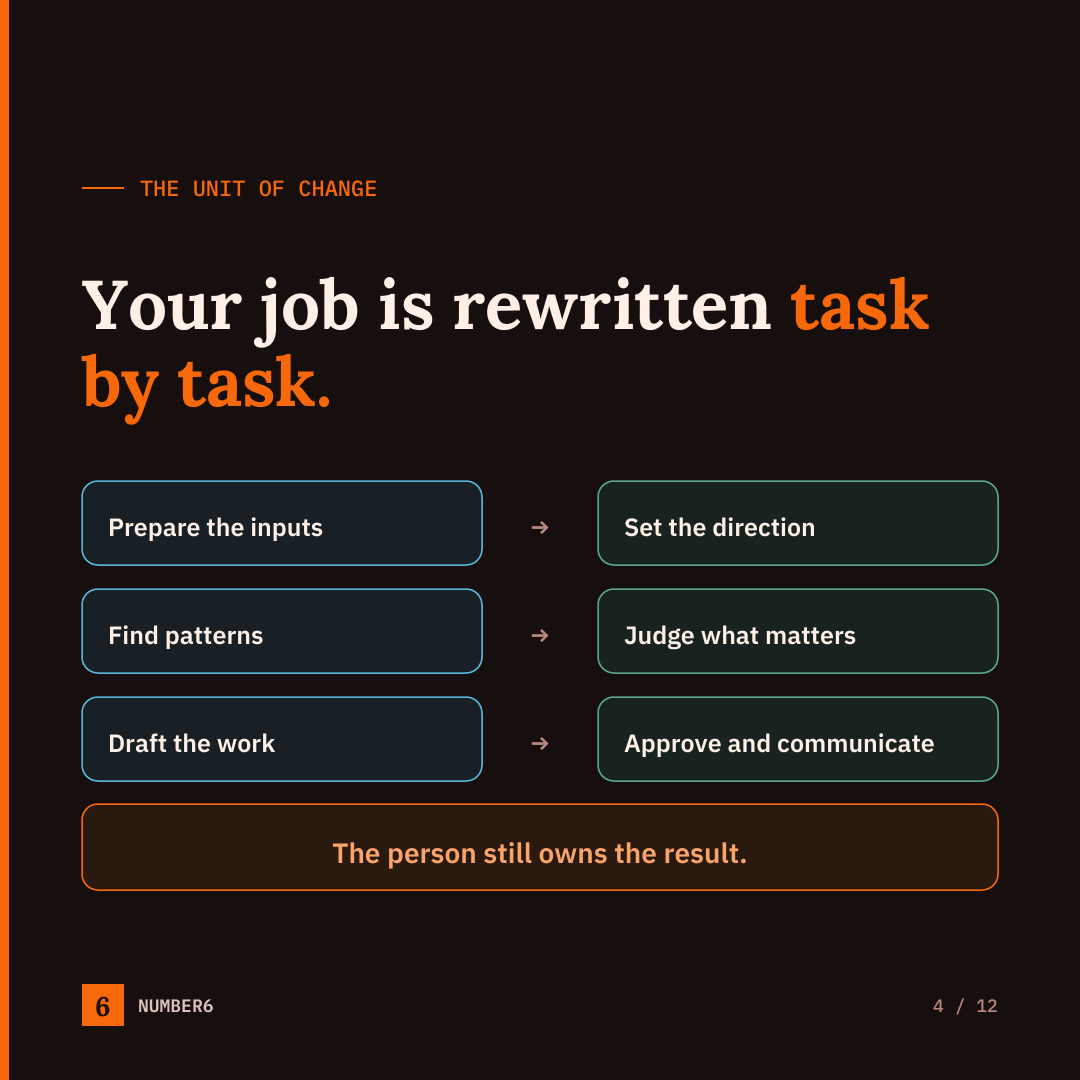
Work rarely changes as cleanly as a job title disappearing on Friday and a new one appearing on Monday. It changes task by task.
A report that took a morning can become a reviewable first draft in a fraction of the time. A first pass through a hundred pages can happen before the meeting starts. A blank presentation can arrive with a structure, supporting material, and a list of the questions it still cannot answer.
Some of those tasks will be automated. Many will be shared between a person and a machine. The rest will become more important because everything around them has become cheaper.
This is already visible in the data. Anthropic's research finds AI use split between automation and augmentation, with augmentation slightly ahead in its consumer product. The World Economic Forum expects nearly 40% of job skills to change by 2030 while human skills such as analytical thinking, leadership, creativity, and collaboration remain critical. The transition is real. It is also messier than the headlines suggest.
So no, we do not know exactly which jobs will exist in five years. Anyone who claims to know is selling certainty they do not have.
We do know the work inside those jobs is changing now.
Access is not the problem anymore.
Most leaders we talk to have tried ChatGPT, Claude, or Copilot. They ask for a summary, an email, or a strategy. The answer is technically competent and practically useless. It sounds like something. It does not know enough to mean anything.
So they conclude that AI is overhyped.
Sometimes it is. But often the problem is simpler: they handed a capable assistant a one-sentence request with no history, no examples, no constraints, and no definition of good. Then they judged it for guessing badly.
Generic context produces generic work.
The next step is not a cleverer prompt. It is a better working relationship.
The new job is to direct the work.
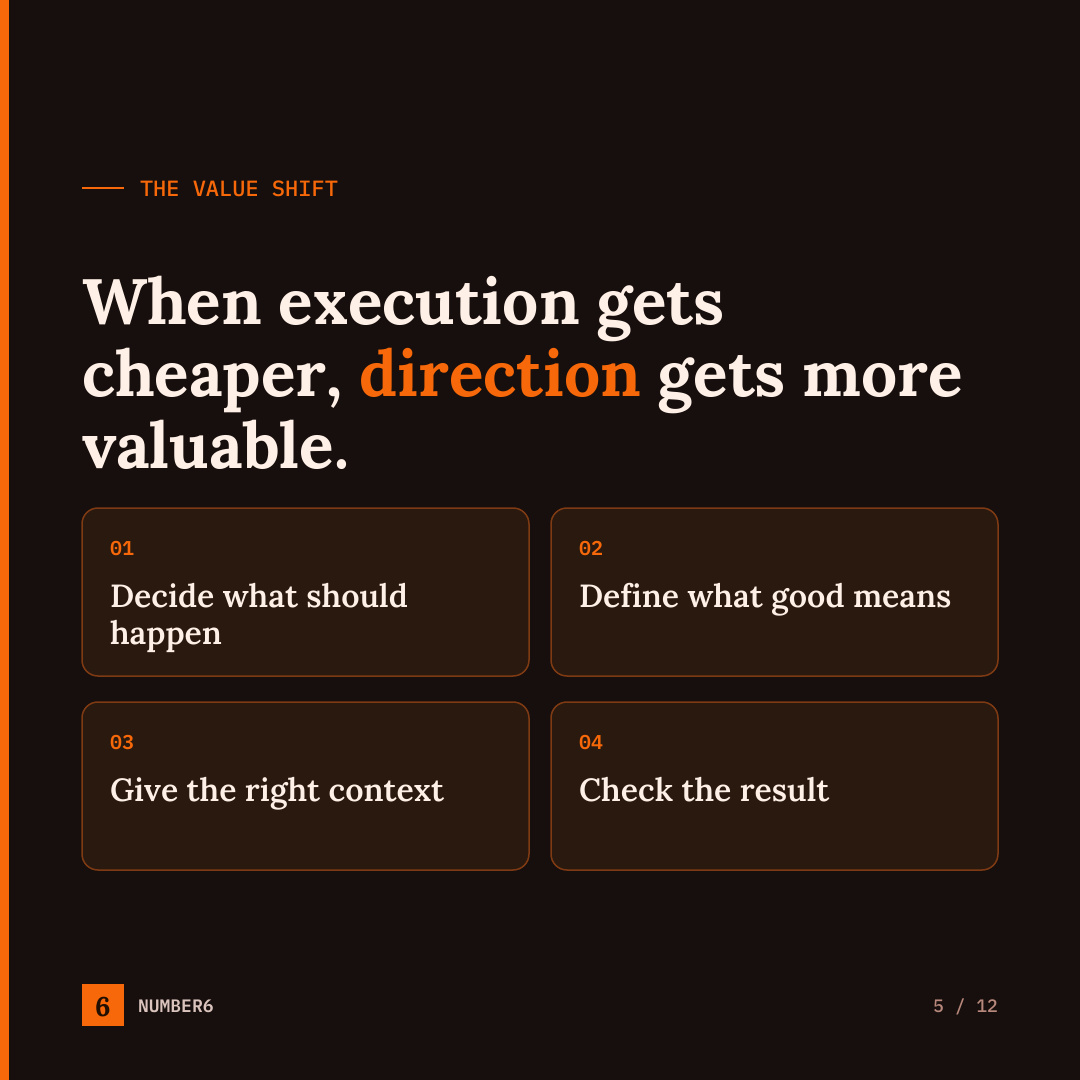
When execution becomes cheaper, direction becomes more valuable.
That does not mean sitting above the work and issuing commands. It means doing the part most people skip because it is hard: deciding what should happen, explaining why, defining what good looks like, and checking whether the result actually meets the bar.
This is what strong managers already do with people. AI makes the practice explicit.
You need to know:
- What outcome matters.
- What context changes the answer.
- What can be delegated and what cannot.
- What a good result looks like.
- How the work will be checked.
- Who remains accountable when it is wrong.
The answer to the last question is still a person.
Microsoft's 2026 Work Trend Index describes its most advanced AI users in similar terms: they delegate routine execution, research, and synthesis while people set direction and take responsibility for how the output is used. The tool may do more of the execution. It does not inherit your accountability.
THE PRACTICE
Six principles for augmented work
01
Change the task before you change the job.
"Automate the finance team" is not a plan. "Prepare the first draft of the monthly variance commentary from these approved sources" might be.
Start where the work is visible. Pick one recurring task, map its inputs and decisions, and decide which parts require judgment. You will learn more from one real workflow than from a month of AI trend reports.
02
Clear intent beats clever prompting.
AI cannot optimize for an outcome you have not defined.
Before you ask for output, specify the audience, the decision the work should support, the constraints, the quality bar, and the ways the result could fail. This is not prompt engineering. It is clear management.
03
Context is the difference.
The same model available to everyone becomes far more useful when it understands your goals, role, projects, terminology, examples, and standards.
That context should not be rebuilt in every conversation. Capture it. Maintain it. Give the system the smallest relevant part for each task. Over time, you are not collecting prompts. You are building an operating system for your work.
04
Delegate workflows, not random requests.
One good answer is convenient. A repeatable process is valuable.
A useful AI workflow has an input, a method, a handoff, and a check. It can prepare a weekly briefing, turn meeting notes into follow-up, compare a new proposal with stated goals, or draft a report from approved data. The work becomes dependable because the process is visible.
05
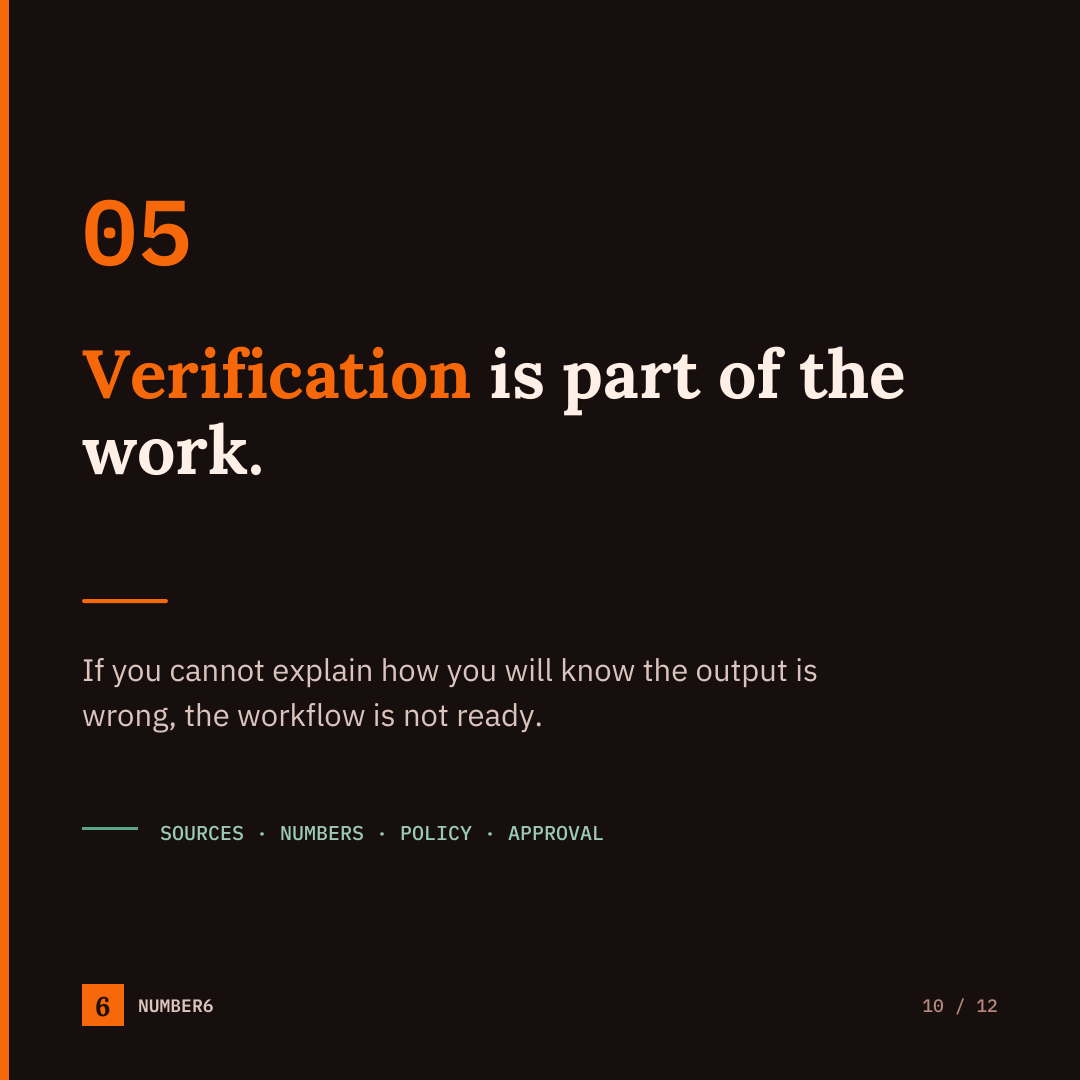
Verification is part of the work.
AI can be fast and wrong at the same time.
Anthropic's own analysis found substantial speedups on complex work, but not perfect reliability. That is the trade-off. The more work you delegate, the more deliberate your checks need to become.
Use source requirements, examples, calculations, second-pass review, approval gates, and clear failure conditions. If you cannot explain how you will know the output is wrong, the workflow is not ready.
06
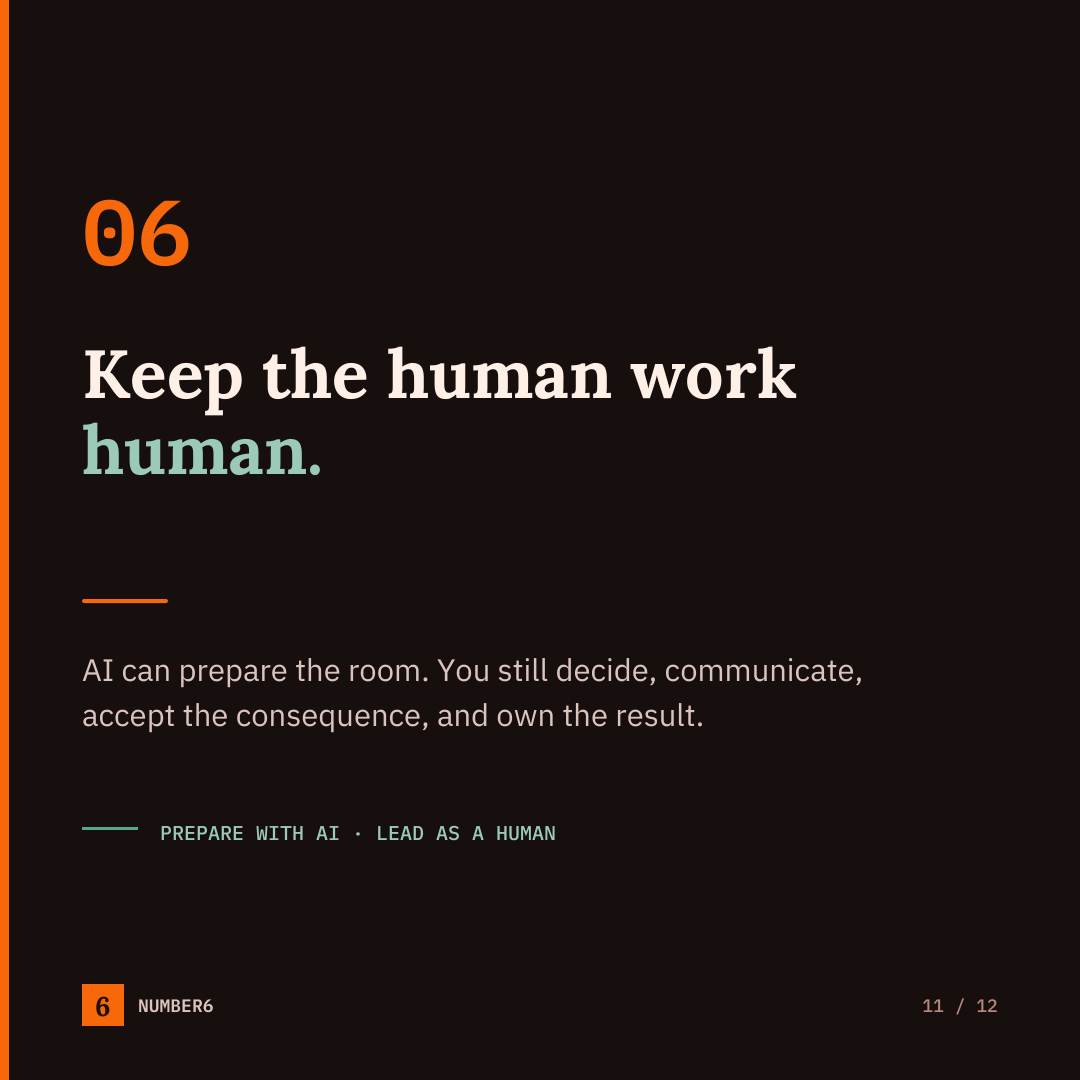
Keep the human work human.
AI can prepare the room. You still have to lead it.
It can organize evidence, surface options, draft difficult language, and show where a plan conflicts with your stated priorities. It cannot carry the consequence of the decision. It cannot repair trust after you break it. It cannot decide what kind of leader you want to be.
The goal is not to remove yourself from the work. It is to spend more of yourself on the work that deserves you.
The catch
(because there is always a catch)
Augmentation takes work before it saves work.
You have to document things that have lived in your head for years. You have to confront unclear goals and inconsistent processes. You have to decide what information can enter which system. You have to review output even when it looks convincing. The first version of a workflow will probably disappoint you.
And some work should not use AI at all.
If the risk cannot be controlled, the information should not be shared, or the task depends on a relationship that automation would cheapen, leave it alone. A spreadsheet, a checklist, or an honest conversation may be the better tool.
This is not a race to put AI everywhere. It is a practice of putting it somewhere useful and learning from what happens.
What this looks like in an actual week
An augmented leader does not spend the day talking to a chatbot.
Their system prepares a morning brief from active projects and open commitments. It turns approved numbers into a first report, then flags the claims that need a source. It builds a meeting pack from the history of an account. It drafts the difficult email in the leader's own language and explains which assumptions shaped the draft. It compares a new request with the goals the leader already committed to.
The leader reads, questions, corrects, decides, and communicates.
The machine handles more of the preparation. The person brings more of the judgment.
That is the promise of augmented work. Not more output for its own sake. More capacity for the work that moves something forward.
OUR POSITION
We believe
We believe AI should increase human agency, not reduce it.
We believe Good context matters more than prompt tricks.
We believe Every delegated workflow needs a named human owner and a visible check.
We believe Private information should stay private, even when convenience argues otherwise.
We believe People learn this by changing real work, not by watching another generic AI presentation.
We believe The best AI system makes your judgment clearer, your work more dependable, and your team less reliant on outside experts over time.
We believe You should start before you feel ready, but smaller than the hype tells you to.
START HERE
Start with one piece of work.
Take one recurring task from last week: a report, a presentation, a briefing, an email, or a decision memo.
Write down the outcome, the context, the quality bar, and the check. Then build the smallest version of the workflow that could help.
That is how you pull ahead. Not by becoming an AI expert overnight. By making one part of your real work better, then doing it again.
FREE COURSE
Build your first augmented workflow.
Turn one recurring leadership task into a repeatable AI-assisted workflow with a reusable brief, a quality bar, and a named human check.
START THE FREE COURSEWORK WITH NUMBER6
Build this around your actual role.
Bring one real leadership workflow. We will tell you whether it belongs in training, coaching, consulting, or none of them.
Book a training consultation